Showing posts with label Unit 1. Show all posts
Showing posts with label Unit 1. Show all posts
Thursday, 28 January 2016
Unit 1: Chapter 9 (Section B)
Chapter 9 is a film I have directed for college, I used this opportunity to put my Arts Challenge into practice which was working on cinematography skills. I feel that overall, I have improved my knowledge and skills of cinematography by doing this challenge. The above film took around five months to plan, shoot and edit. I took the main lead in cinematography so I could work on my Arts Challenge and overall I am very proud of the final product. I did not focus on mimicking Kubrick or Anderson's work in this project but I was definitely influenced by their general style. I aimed to incorporate some somewhat symmetrical shots from time to time.

Unit 2: Film Stills (Section B) 5

In this shot, I think the lighting went really well in terms of how the background has become solid black and Simon is set out from it quite nicely. Usually, close-ups emphasise emotion of characters most potently, however I think the framing, shot size and low angle portray the emotion intended particularly well.
Unit 1: Film Stills (Section B) 4

When initially setting this shot up I did not realise how much I actually liked it, but there are a number of things I feel went particularly well in this shot. First of all the focus went as close to perfect as possible. The shallow focus draws the viewers attention to the 'I' key which was my main intent. The lighting also created a very crisp image and the clarity of the dust in between the keys gave a nice effect, I feel. I also like the central framing of the 'I' key, although framing the subject in the centre is nothing out of the ordinary, I think with this particular subject matter it creates a nice image.
Unit 1: Film Stills (Section B) 3

I enjoyed incorporating a bird's eye view shot into the film. I tried to create a somewhat symmetrical shot and have the main subjects focused vertically down the centre. I think this shot went particularly well in terms of the framing and positioning of the mise-en-scene.
Unit 1: Film Stills (Section B) 2

This is one of my favourite shots from our film. I feel that this shot was framed particularly well, especially for an over the shoulder shot which, usually, I do not like that much. The lighting of the shot is also something I am quite proud of, the heavy reflections of the water on the ground provide nice contrast to the solid black sky. I also think the view of the well-lit town hall adds nice depth to the shot.
Unit 1: Film stills (Section B)
Before starting the course at the Showroom, I had began the planning for a short film as part of my college course. We began shooting after the arts award had been briefed so I have chosen to use some stills from the film which I put a lot of effort into the cinematography. The next few posts will consist of still from my film 'Chapter 9'.
Here is a link to the film and IMDb page to prove I directed/wrote the film:
https://www.youtube.com/watch?v=e24iLYMQHuY
http://www.imdb.com/title/tt5372052/?ref_=nm_flmg_wr_1

This close up is from the beginning of the film. I feel this is a particularly good shot as it is well framed and chiaroscuro creates a great effect in terms of tone.
Here is a link to the film and IMDb page to prove I directed/wrote the film:
https://www.youtube.com/watch?v=e24iLYMQHuY
http://www.imdb.com/title/tt5372052/?ref_=nm_flmg_wr_1

This close up is from the beginning of the film. I feel this is a particularly good shot as it is well framed and chiaroscuro creates a great effect in terms of tone.
Wednesday, 27 January 2016
Unit 1: The Showroom (Section D)
I have attended a course hosted by the BFI at The Showroom cinema in Sheffield. The Showroom is an independant cinema and is also funded through charity. I heard about the course via the Showroom's website. As I want to be a filmmaker (I will go on to study film production at university) I thought this would be an excellent opportunity to gain more experience in filmmaking and further my knowledge of the industry.
Many opportunities were provided by this course such as a networking workshops and experience in multi-cam TV work. The course was brilliant way to bring together students with similar interests from different locations.
Rob Speranza from South Yorkshire Film Makers Network (SYFMN) came in to give us a workshop about networking. He told us the basic necessary skills that would help us in social situations such as networking. This was extremely beneficial as the confidence gained from this workshop will help when faced with these types of situations in my career.
We were given access to equipment similar to what is used in television studios, we were then able to create a series of interviews using two cameras. This was a great bit of extra experience which was only possible due to The Showroom's and BFI's resources.
Many opportunities were provided by this course such as a networking workshops and experience in multi-cam TV work. The course was brilliant way to bring together students with similar interests from different locations.
Rob Speranza from South Yorkshire Film Makers Network (SYFMN) came in to give us a workshop about networking. He told us the basic necessary skills that would help us in social situations such as networking. This was extremely beneficial as the confidence gained from this workshop will help when faced with these types of situations in my career.
We were given access to equipment similar to what is used in television studios, we were then able to create a series of interviews using two cameras. This was a great bit of extra experience which was only possible due to The Showroom's and BFI's resources.
Tuesday, 26 January 2016
Unit 1: The Revenant Review (Section C)
A masterpiece. If I was to generalise the entire 156 minute feature to just one word that would be it- Masterpiece. After winning several Oscars, including best directing and best film, in 2015 for his film 'Birdman', Alejandro G. Iñárritu completely silences me with this truly great work. I have no doubt that The Revenant will completely dominate the Oscars this year, and I am very glad about it.
In terms of the story, it is beautifully written, a captivating narrative which was executed to complete perfection. From the very first moment right until the last I was engulfed in the drama, thrill, and grit of this amazing piece.
Leonardo DiCaprio's performance was one of the many films greatest attributes. DiCaprio has always been a stellar actor, but his role as Hugh Glass was on another level. It comes as no surprise that he has a nomination for best leading actor, an award he fully deserves. Likewise, Tom Hardy is up for the award of 'best supporting actor' for his portrayal of Fitzgerald in The Revenant. I am more the delighted to believe that Hardy's performance was completely on par with DiCaprio. Both performances were outstanding and further lost me in the fiction; to me these are the best performances of the actors' careers and I would very much like to see someone top this. However, the rest of the cast gave exceptional performances. Domhnall Gleeson and Will Poulter gave staggering portrayals of their characters and, after this, the two actors will be taking on great opportunities in their careers.
But... THE most important and groundbreaking element of The Revenant is the cinematography. Never have I been in such awe at the cinematography of a film; visual poetry is a very accurate way to describe it. Being a fan of Kubrick I have developed an eye for cinematography and I can say without a doubt the Iñárritu has reached an equally astonishing level as Kubrick did. Movement in the tracking shots and pans is so fluid, as though a picture is being painted or even a sculpture carved and that is exactly what is done. Equally astounding was the fact the entire film was shot using only natural light. An unbelievable piece of information but something Iñárritu and Emmanuel Lubezki can only be applauded, perhaps worshiped for their efforts in the stunning visuals of this film- truly remarkable.
Viewing the film in IMAX was a surreal experience in how real it actually felt, it was unbelievable how involved in the films environment I felt. I would recommend - in fact insist - that anyone should watch this film in the cinema. A very unique but amazing experience; one of, if not, the best cinema experience I have had.
In terms of the story, it is beautifully written, a captivating narrative which was executed to complete perfection. From the very first moment right until the last I was engulfed in the drama, thrill, and grit of this amazing piece.
Leonardo DiCaprio's performance was one of the many films greatest attributes. DiCaprio has always been a stellar actor, but his role as Hugh Glass was on another level. It comes as no surprise that he has a nomination for best leading actor, an award he fully deserves. Likewise, Tom Hardy is up for the award of 'best supporting actor' for his portrayal of Fitzgerald in The Revenant. I am more the delighted to believe that Hardy's performance was completely on par with DiCaprio. Both performances were outstanding and further lost me in the fiction; to me these are the best performances of the actors' careers and I would very much like to see someone top this. However, the rest of the cast gave exceptional performances. Domhnall Gleeson and Will Poulter gave staggering portrayals of their characters and, after this, the two actors will be taking on great opportunities in their careers.
But... THE most important and groundbreaking element of The Revenant is the cinematography. Never have I been in such awe at the cinematography of a film; visual poetry is a very accurate way to describe it. Being a fan of Kubrick I have developed an eye for cinematography and I can say without a doubt the Iñárritu has reached an equally astonishing level as Kubrick did. Movement in the tracking shots and pans is so fluid, as though a picture is being painted or even a sculpture carved and that is exactly what is done. Equally astounding was the fact the entire film was shot using only natural light. An unbelievable piece of information but something Iñárritu and Emmanuel Lubezki can only be applauded, perhaps worshiped for their efforts in the stunning visuals of this film- truly remarkable.
Viewing the film in IMAX was a surreal experience in how real it actually felt, it was unbelievable how involved in the films environment I felt. I would recommend - in fact insist - that anyone should watch this film in the cinema. A very unique but amazing experience; one of, if not, the best cinema experience I have had.
Monday, 18 January 2016
Unit 1: The Machinist Review (Section B)
The Machinist (Brad Anderson, 2004) is a psychological thriller about a troubled man who experiences strange hallucinations which begin to piece together and remind him of a terrible event which took place a year before the film is set.
Christian Bale's wonderful performance brings to life a man who "would not exist" if he was any thinner. Clearly dedicated to the role, Bale lost 63 Pounds in order to portray insomniac Trevor Reznik; he creates a very in depth character which I found to be very believable and original.
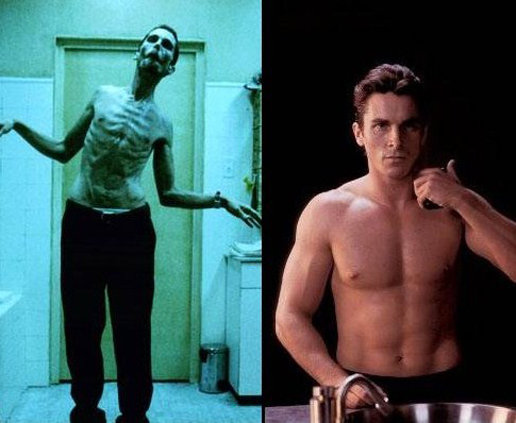
The use of colder colours throughout The Machinist offer an unsettling tone to the film and help the viewer to identify with the gritty world. There isn't a particular amount of cinematographic 'flare' but it is not something I feel is a necessity in such performance driven film. The use of cold filters are the only notable aspect of the movie's cinematography but they are used subtly and offer a very original look to the film.
The score for the film was very interesting. At parts, a friend and myself noted that it was somewhat reminiscent of some of the music from Star Wars (NOT the most known Star Wars theme or the theme of Darth Vader).
In terms of narrative, I would say it is extremely good, I did not notice any major plot holes or issues. The twist of the film was perfectly executed and brought together all the pieces of the film. Foreshadowing and subtle hints were made throughout the film which were tied up nicely when the twist is revealed making for an overall intense but concise plot that provokes thought and something I found very interesting.
The Machinist is very cleverly written and executed and such a smart and concise manner. I found the film extremely entertaining as well as thought provoking and, in parts, traumatising.
Friday, 4 December 2015
A Clockwork Orange
Kubrick’s
A Clockwork Orange also reflect his style as an auteur particularly well
especially regarding the themes of which Kubrick shows interest in and the way artistic concepts are
explored. Again, A Clockwork Orange can very much be considered to
post-modernistic, and it is the way in which Kubrick explores his interest in
human nature, mainly the darker side, that generates the depiction of
post-modernism.
A
consistency throughout many of Kubrick’s works is the prominence of
‘psychopathic’ characters. Alex is the most obvious when discussing Kubrick’s
psychopaths; his lack of empathy is the most clear indication of his
psychopathic tendencies. He enjoys violence as an art form, picks his victims
at random, is very sexually promiscuous and pursues his fantasies of dominance
and power. But what makes Alex even more sadistic is the fact he has a
tremendously attractive side; he has an admirable appreciation for classical
music, he is extremely witty and smart and is often considered quite handsome. Kubrick once said “I'm
interested in the brutal and violent nature of man because it's a true picture
of him.”
Similarly
to 2001, the score in A Clockwork Orange is undeniably great. From Beethoven to
the edgy synths, Kubrick’s use of sound is well executed and something
distinguishes him as an auteur. Moreover, Kubrick’s striking cinematography is
also consistent in A Clockwork Orange, especially the use of wide camera angles
making for some quite distorted shots. Long tracking shots are also a notable
technique of Kubrick’s, mostly prominent in The
Shining, however A Clockwork Orange includes these shots frequently.
2001: A Space Odyssey
As
mentioned earlier, 2001 is loaded with Kubrick’s picturesque cinematography;
the visuals of this film are one of the most crucial elements in terms of
Kubrick’s style. As previously mentioned, his emphasis on the purely photographic
elements of his scenes through the drawn out shots is prominent in 2001.
The
exploration of the artistic concept of modernism is an equally significant
element in defining Kubrick’s style, mostly due to its coverage of human
nature. Again, Kubrick and Arthur C. Clarke’s hoped that 2001 raised more
questions than it answered, and it did. Kubrick was pleased that people had
such philosophical experiences.
Although the film does not directly refer to the human condition it still
provokes thought regarding all aspects of the human experience.
One
of the most significant elements of 2001 is the score included by Kubrick. A
great music score is a definitive part of Kubrick’s style as an auteur. The
score was meticulously selected by Kubrick; the comparison of the songs used in
2001 to the ones that were discarded is huge and it is undeniable that Kubrick
worked extremely hard to get the perfect score. Another interesting way that Kubrick has used sound is
the lack of dialogue; a whole eighty eight minutes of the film are completely
dialogue free. This was Kubrick’s intention so that the audience would focus
more on the visuals of the film.
Post-Modernism in Kubrick's A Clockwork Orange
Post-modernism
was prominently explored in Kubrick’s A Clockwork Orange, particularly in
regards to Alex’s love of Beethoven. A heavily present component of
post-modernism in A Clockwork Orange is the act of taking something already existent
and changing it in some way. Alex has a great appreciation for Beethoven; a
particular scene shows Alex returning home after a night of violent antics, he
goes on to say that listening to Beethoven would ‘top off’ his night. Horrific
scenes, including a woman being hung, are shown whilst Beethoven’s 9th
plays. The juxtaposition of the classical music alongside Beethoven is a post
modernistic notion.
Another
overtly explored element of post-modernism is the way social forces aim to
shape an individual’s identity. Alex is a clearly unique character with very
particular interests such as his love of violence as an art form. Authoritative
figures aim to correct Alex’s behaviour by forcing him to watch disturbing
scenes whilst listening to Beethoven. Despite Alex’s despicable nature, Kubrick
creates a sense of sympathy for Alex due to the fact he is being torn of his
individual identity.
Modernism in Kubrick's 2001: A Space Odyssey
Kubrick
explores various artistic concepts in his work, and prominently so. The
exploration of these concepts is another identifiable element of Kubrick’s
style as an auteur.
Modernism
is distinctly explored in 2001: A Space Odyssey. An aspect of modernism that is
overtly present in 2001 is the pursuit of answers to fundamental questions about
the human experience; Kubrick’s interest in human nature is addressed again
here. The film is established for its philosophical provocation; Kubrick
himself stated that he wanted 2001 to generate many philosophical questions.
Modernism may also concern the celebration of technology and machinery, a
concept clearly explored by the inclusion of the character ‘HAL 9000’ and how
the role of technology may affect mankind. Although HAL is not depicted in a
positive manner, the comparison of technology and humanity is a notion of
modernism. Moreover, favouring the primitive over the industrial is an element
of modernism which is also very potent in 2001 from the ‘Dawn of Man’ sequence
and the overall theme of evolution. Technology and primitivism are explored
somewhat mutually, despite neither being particularly favoured. Stanley Kubrick’s vision, in
terms of his curiosity over humanity, also makes this film an extremely
prominent example of modernism.
Wes Anderson's Symmetry
Wes Anderson // Centered from kogonada on Vimeo.
Symmetry is an obvious, prominent component in all of Wes Anderson's films. Similarly to effect of Kubrick's 'one-point perspective', Anderson's use of symmetry places the subject(s) in such positions wear attention is drawn in a creative manner. Anderson creates perfect symmetry which, I feel, creates the most striking visuals in even the most simplistic shots (in regards to actual content).
*I will try to produce some similar symmetry based shots in a later post
Stanley Kubrick's 'One-Point Perspective'.
Stanley
Kubrick’s ‘One-Point Perspective’ is a subtle component used in many of his
shots. Although only a small feature, it makes for very unique cinematography. His background in
photography, again, has a great role to play in these creative visuals.
Kubrick // One-Point Perspective from kogonada on Vimeo.
When I first started watching Kubrick's films, I noticed something particular about most of the shots, in terms of perspective. However, I struggled to explain what it was exactly; the way he positions the subject(s) creates the 'one-point', and focus is drawn to this either by other characters or environments which channel the viewers attention to the subject.
*I will try to recreate this effect in an image in a later post.
Stanley Kubrick - Auteur
Auteur Theory considers a director to be the
creative force behind a film. They are depicted as an ‘author’ with a distinctive
style, noticeable in their works. From his 1968 Sci-Fi epic, 2001: A Space
Odyssey to the more controversial A Clockwork Orange, Stanley Kubrick is
considered one of the most revolutionary directors of the 20th
Century, but what is it that defines him as an auteur?
Stanley
Kubrick grew up with a love of chess and photography. By age thirteen, he had
already found his passion after his father bought him a Graflex Camera. After
developing a love for still photography, Kubrick pursued every photographic
opportunity he found, from working as the school photographer at William Howard
Taft High School, to working as a professional photographer at Look Magazine.
Kubrick
has stated that he takes great interest in the human condition, particularly
the darker side of human nature. Before he delved into cinema it is clear of
this particular interest through his photographic works; mostly capturing
images of natural human behaviour.
In Kubrick’s early documentary shorts, his
passion for photography is prominent in the cinematography; opening with varied
picturesque scenes, Kubrick instantly signifies his visually stunning style as
an auteur and how still photography began to shape his manner of filmmaking. Additionally
both of Kubrick’s early documentaries focus on particularly interesting people;
thus reiterating his admiration of human nature.
Kubrick’s photographic influence became even more profound
as he progressed in his film career. Although every film made by Kubrick is a
cinematographic masterpiece, a particularly outstanding one is Barry Lyndon. Using a lens from NASA and
his photographic expertise, Kubrick’s aim was to make the film look like an 18th
Century painting.
Long, extensive shots are also a notable technique of
Kubrick’s, prominent in 2001: A Space Odyssey. The use of these extremely
endured takes allowed him to emphasise the visual, cinematic quality of the
shots; again signifying the influence photography had over Kubrick’s work.
Saturday, 28 November 2015
The Royal Tenenbaums Review
In order to produce this visually stunning film, Anderson worked alongside cinematographer Robert D. Yeoman, someone who Anderson worked on all of his films with. Yeoman has been nominated for a BAFTA and Oscar in cinematography and has won many other awards in this role, clearly a skilled cinematographer and a brilliant staple of Wes Anderson's unique visuals.
As in all Anderson's films, The Royal Tenenbaums sticks to a colour palette, consisting mainly of pastel light blues and darker pastel reds and browns. Alongside this palette, Anderson sticks to his authentic symmetry making for wonderful perspectives and something that I feel only further drives the film.



Medium shots were something of a surprising element I found prevalent throughout the film.
Unit 1: Arts Challenge (Section A)
Silver Arts Award
Arts Challenge
-What is your idea?
My idea is to look at the visual style of unique auteurs. I will be looking at mainly cinematography and directors who have complete creative control over the cinematography in their films. I aim to see if I can replicate the visual style of some directors and hope to develop a style of my own as a director. I will focus on the work of Stanley Kubrick and Wes Anderson. I also hope to look into an auteur I have not yet discovered whose style also lies greatly in their cinematography.
-Why have you chosen the challenge?
I am interested in directing and cinematography. One of my favourite auteurs is Stanley Kubrick and I really enjoy the visual style of his films. I want to develop my cinematographic skills by constructing creative shots and drawing influence from visually brilliant directors. I also aim to develop a unique style as a director.
-What are the practical steps to achieving your challenge?
I will examine the visual style of Stanley Kubrick and Wes Anderson and carry out some shooting of my own and experiment with different types of shots. If I am able to access the resources, I may also try to replicate some shots from their films.
Subscribe to:
Posts (Atom)